Mapping Contraceptive Access Policies
State policy plays a powerful role in determining whether someone can access the contraceptive care they need to support their sexual and reproductive well-being. In recent years, many states have taken steps to expand access by codifying the Affordable Care Act (ACA) contraceptive coverage mandate, requiring insurance coverage of extended contraceptive supplies, and authorizing pharmacists to prescribe contraception.
Despite this national momentum, Pennsylvania has not adopted any of these policies, leaving residents without safeguards shown to reduce financial and logistical barriers to starting or consistently using their preferred contraceptive method.
PA Catalyst is conducting policy analyses and implementation science studies on these three contraceptive access policies to inform evidence-based policymaking in our state.
As part of this work, we developed a state-level dataset capturing policy enactment from 2013-2025 and created a series of maps highlighting Pennsylvania's policy context within a changing national and regional landscape.
PA Catalyst Contraceptive Policy Priorities
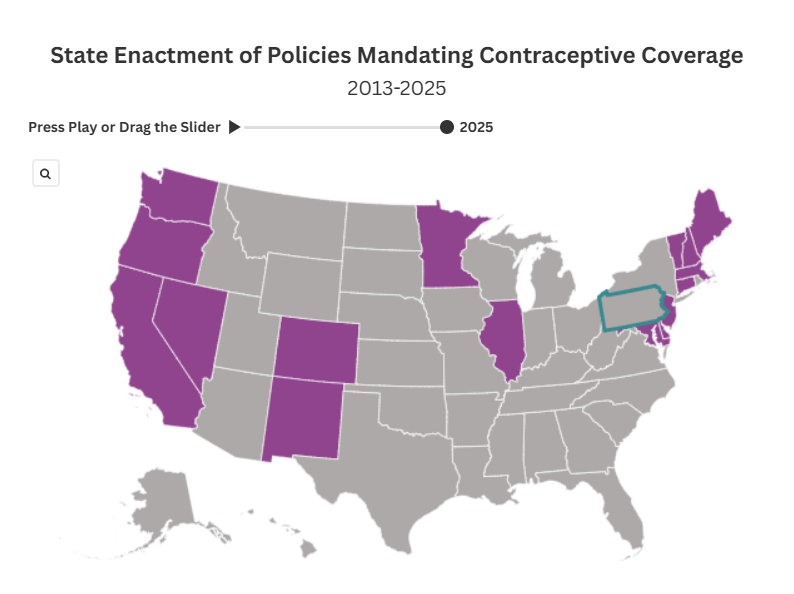
Codification of the ACA Contraceptive Coverage Mandate
State policies requiring insurance plans to cover the full range of FDA-approved contraceptive methods and related services with zero out-of-pocket costs, such as copays or deductibles.
Explore our national and regional ACA codification policy maps ▸
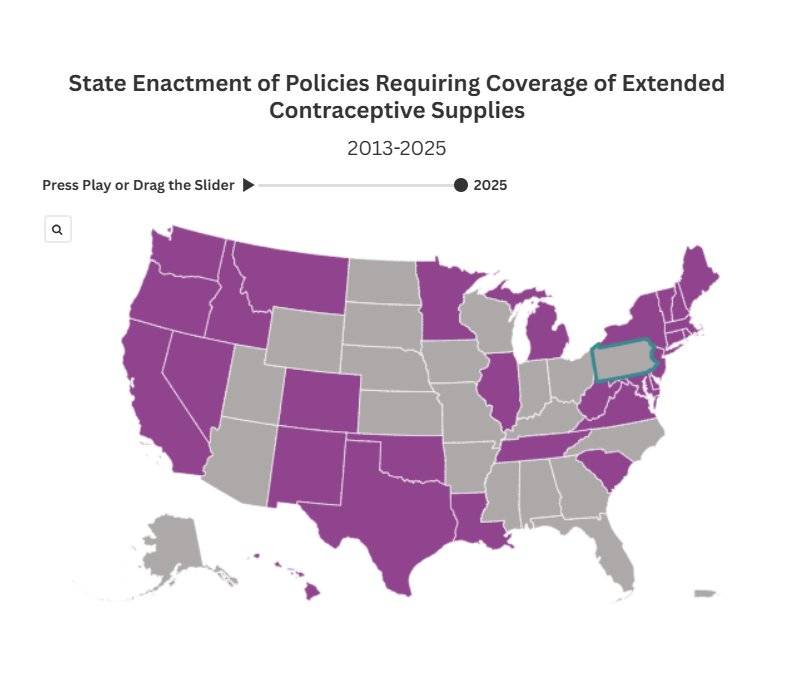
Coverage of Extended Supply of Contraception
State policies requiring insurance plans to cover the provision of more than one month of contraceptive supplies (e.g., oral contraceptive pill packs) at a single prescription fill
Explore our national and regional extended supply policy maps ▸
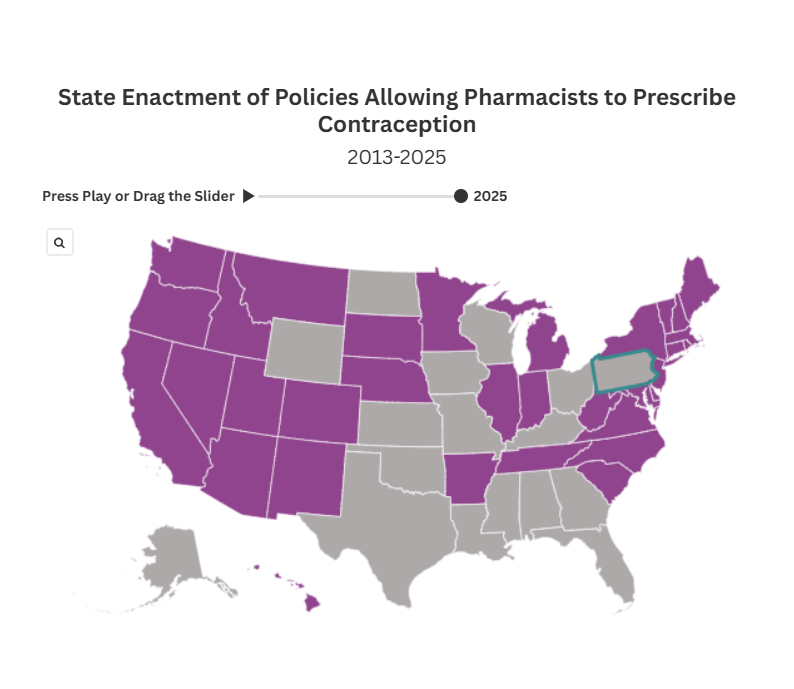
Pharmacist Prescription of Contraception
State policies allowing pharmacists to prescribe and dispense contraception directly to patients without requiring a prescription from another clinician (e.g., physician, nurse practitioner).
Explore our national and regional pharmacist prescription policy maps ▸
Putting These Policies Together
Our integrated national policy map displays how many of these three policies of interest have been enacted in each state. To see changes over time, press play or drag the slider on the map to view a specific year. Hover over a state to see whether it has enacted policies codifying the contraceptive coverage mandate, ensuring coverage for extended supply of contraception, and/or allowing pharmacist prescribing of contraception.
17
states and Washington DC have enacted all three policies
35
states and Washington DC have enacted at least one policy
Where does Pennsylvania stand?
As our integrated regional policy map shows, Pennsylvania is increasingly an outlier. All neighboring states except Ohio have enacted at least two of the three policies of interest that expand contraceptive access, whereas Pennsylvania has not adopted any. As a result, it may be harder for Pennsylvanians to access contraception than those living just across state lines.
Our Approach
To create our policy dataset, we drew on policy tracking conducted by Birth Control Pharmacist, Guttmacher Institute, KFF, The National Conference of State Legislatures, Population Reference Bureau, and Power to Decide. We adapted the Center for Public Health Law Research’s (CPHLR) legal mapping methodology to collect detailed data over time from primary legal and policy sources. Use our data request form to obtain additional details about our methodology.

From Policy Maps to Policy Insights
PA Catalyst is using this policy data to conduct difference-in-differences analyses comparing health outcomes between states that have implemented these policies and states that have not. This approach will allow us to model the potential impact of adopting one or more of these policies in Pennsylvania.
Building on these analyses, we will create policy briefs that highlight evidence-based policy opportunities and share them with individuals in Pennsylvania best positioned to turn our insights into action. This work also will be informed by external partners in other states that have enacted and implemented these policies. We will learn from their experiences and share our own lessons learned to support enactment and implementation of expansive contraceptive access policies nationwide.
Are you interested in using our contraceptive policy data in your own work?
Click below to request access to our policy documentation, datasets, and interactive maps.